Your Clients' Questions Are Your Law Firm's Blog Plan
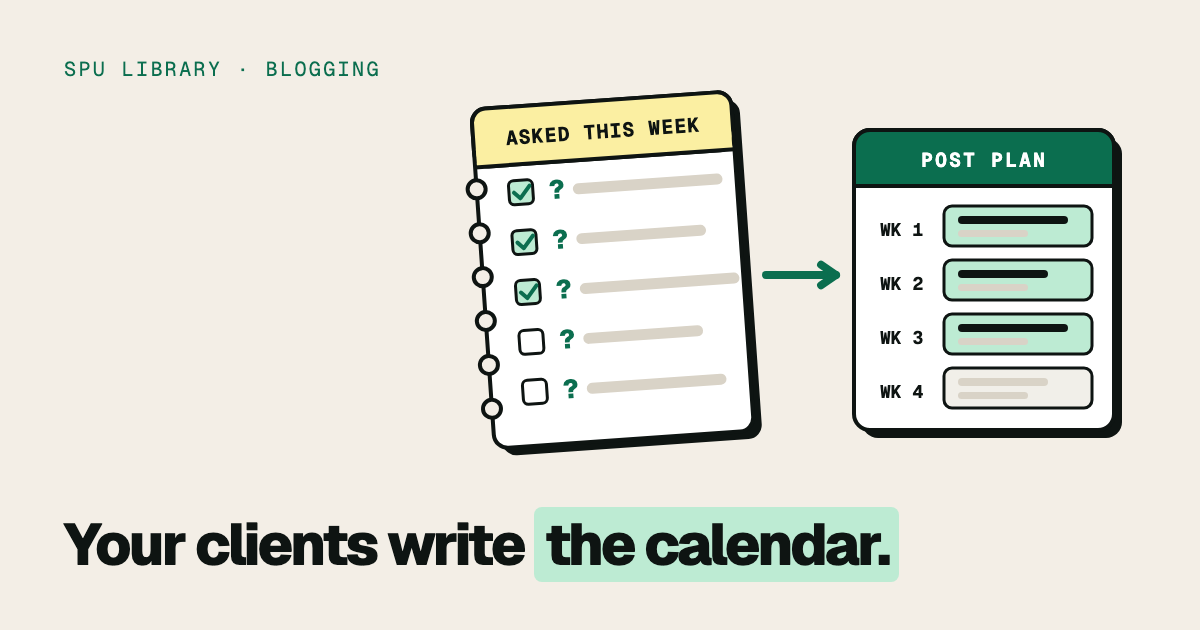
- For lawyers, the best blog topics are the questions clients and prospects already ask on the phone and in consultations.
- Keep a question log, rank it, and publish one short answer a week instead of guessing at topics.
- AI can sort the log and tidy drafts, but the jurisdiction-checked answer, the local detail and confidentiality stay with you.
Most lawyers who stall on a blog don't stall on the writing. They stall on the blank list of topics. Ask an AI tool for "20 blog ideas for a family law firm" and you'll get a tidy list, the same tidy list every other family lawyer got. Your real topic list is already written. Your clients and prospects dictate it to you every week, on the phone and across the conference table.
The questions you answer every day
Solo Practice University's Legal Blogging course, taught between 2007 and 2010, made this point in a short lesson called "Client questions should become blog post." The instructor described how a new firm blog climbed in search results quickly, and why:
"What I soon discovered was the simple fact those questions I was getting every day either on the phone or in person from clients and prospective clients were some of the same search terms people were typing into Google and Yahoo."
The questions were basic, the lesson said, and easy to answer. That was the point. A person typing a question at midnight isn't looking for a treatise. They want the answer a lawyer would give across the desk.
A companion lesson took on the worry many lawyers still have, that answering questions for free gives away the store. The course's reply was blunt: "People are starving for legal information." Answer what they're searching for, it argued, and when they need a lawyer they'll remember who answered. And one line in the original lesson matters more now than it did then: "Of course I never used names or anything that might identify someone in the blog post." We'll come back to that.
Keep a question log
The course's fix for writer's block was low-tech: a desktop folder of post ideas, a drafts folder in the blog editor, and a notebook for ideas that arrive away from the computer. "Don't forget about pen & paper." The method was simple. Catch the idea when it shows up, because it won't come back on command.
Turn that into a question log. One line per question, recorded the day it comes up:
- The question in the client's own words. "Can my ex move the kids out of state?" not "parental relocation."
- Where it came up. A consultation, an intake call, an email, a question at a talk.
- The matter type. So you can see which practice areas generate the most questions.
- What they were actually worried about. The fear behind the question is often the better post.
- No names, no dates, no facts that point to a person. The log is a list of questions, not a list of clients.
After a month, count. The questions that show up three, four, five times are your first posts. That's an editorial calendar nobody else in your market has, because nobody else had your calls. It also gives you a ready answer if you've ever worried about blogging when you don't feel like an expert: you're not claiming expertise, you're answering what you were asked.
From question to post
Plan before you publish
The course was honest that "Blogging takes preparation." A later lesson on keeping momentum listed the questions to settle before the first post, starting with "Who is my target audience?" and "What specific topics will I cover on my blog?" Then it gave an exercise most lawyers skip: "write three whole blog posts. Don’t put any of them up yet!" Read the first one again after the third. You'll see how your writing changed, and you'll know you can keep it up.
On how much to write, the course ended up modest. One of its last lessons said: "Write one post of 350 to 500 words once a week." What to write about? "Write about a common problem. Answer a question." A question log turns that from advice into a plan. Pick the top question, write the answer, publish, and move down the list.
If you want the case for opinion, voice and consistency in more depth, our earlier piece on legal blogging when AI can write a post in seconds draws on the same course.
Where AI helps, and where it gets the answer wrong
AI tools are good at the clerical half of this. They can sort a log of 80 questions into clusters, spot the five that are really the same question, turn your dictated answer into a first draft, suggest headings and draft a meta description. That's the business side of a blog, and it's a sensible place to hand off work.
The answer itself is where AI drafting goes wrong, in predictable ways:
- It answers the national version. Ask a general-purpose chatbot about relocating with children, and it will describe how "many states" handle it. Your client lives in one state, in front of one set of local judges.
- It states things confidently whether or not they're right. A deadline, a filing fee or a threshold can come back wrong and read just as smoothly as the rest. Every rule in the post needs checking against the source, the same discipline that stops hallucinated citations in a brief.
- It rewrites the question into keyword-speak. A client asks "Can my ex take the kids to Texas?" The draft says "Understanding Parental Relocation Laws." The client's wording is the better headline, and it's the wording other people search.
- It doesn't know what happened next. It hasn't seen the step most people miss, the form clerks reject, or the conversation that usually follows the question. You have.
John O'Connor, founder of Associate and SPU's Professor of AI Fluency, names the trap:
"The lethal AI habit for lawyers is cognitive surrender of work product."
A public answer to a legal question carries your name. Let the tool organize and tidy. Write the answer yourself, check it against your jurisdiction's law, and say what you'd actually tell the person across the desk. And before you paste intake notes or client emails into any AI tool to "find the questions," check the vendor's data terms and your own jurisdiction's rules.
Strip the client out of the question
The course's habit of never using names was a good start. The current ethics guidance asks more. In ABA Formal Opinion 480 (March 6, 2018), on confidentiality for lawyer blogging and other public commentary, the ABA's ethics committee opened with this:
"Lawyers who blog or engage in other public commentary may not reveal information relating to a representation, including information contained in a public record, unless authorized by a provision of the Model Rules."
Calling a story a hypothetical doesn't fix it, either. The opinion says a violation "is not avoided by describing public commentary as a 'hypothetical' if there is a reasonable likelihood that a third party may ascertain the identity or situation of the client from the facts set forth in the hypothetical" (see also this summary of the opinion). The opinion is based on the ABA Model Rules. Your state's rules and opinions control, so check your own jurisdiction's rules. SPU's older list of social media ethics issues for lawyers shows how easily a casual post can give a client away.
A question log built the right way helps here. You're blogging the question many people ask, not the facts of the person who asked it this week.
Before a client question becomes a post
- Asked more than once. A common question, not one client's story.
- No identifying facts. Nothing a reader could trace to a person.
- "Hypothetical" isn't a shield. Public record isn't either.
- Answer checked for your jurisdiction. Not the national version.
- Written by you. AI organizes; you answer.
Answer like a local lawyer
The course was also honest about a limit. A 2009 lesson warned that "blog readers aren't typically buyers." Many readers are browsing, and some are other lawyers. Question-driven posts are a partial answer, because the person asking "what happens at my first hearing?" usually has a hearing coming.
The other part of the answer is place. O'Connor describes what a law firm is now competing for as "share of local and share of AI voice": showing up in the map results and in the AI-written summary when someone nearby asks. The questions in your log come from people in your area, about your courts and your procedures. Answer them with that local detail, and you have something a generic page can't copy. Our post on how lawyers get found when AI answers the question covers the measurement side, including tracking which locations produce cases.
Every answer post should also point somewhere: to the matching practice page and the contact details on your website. If you're not sure those pages do their job, SPU offers a free law firm website review. And if a question gets asked often enough, it may deserve a short video answer as well as a post.
The course covered much more than topic planning: naming a blog, the pages a business blog needs, categories and tags, comments, and a long Twitter series that now reads as history. For more from the archive, browse SPU's marketing posts.
Plan it with other solos
A question log is easier to keep when someone asks you how it's going. SPU membership gets you the community, monthly strategy sessions and the course library, so you can compare notes on what your clients are asking and what's working.
Get one practical lesson for your firm every week.
Free, from practicing lawyers. Every issue includes a lesson from the archive. Unsubscribe anytime.
The SPU Team writes and edits Solo Practice University's articles. Susan Cartier Liebel founded SPU in 2009 to teach lawyers the practical side of building a practice, the part law school leaves out, with courses taught by practicing lawyers. Today SPU is a community for solo and small-firm lawyers, with an AI Fluency program for firms putting AI to work. Nothing here is legal advice: check your own jurisdiction's rules.
About Solo Practice University →