How Lawyers Build a Social Security Practice With AI
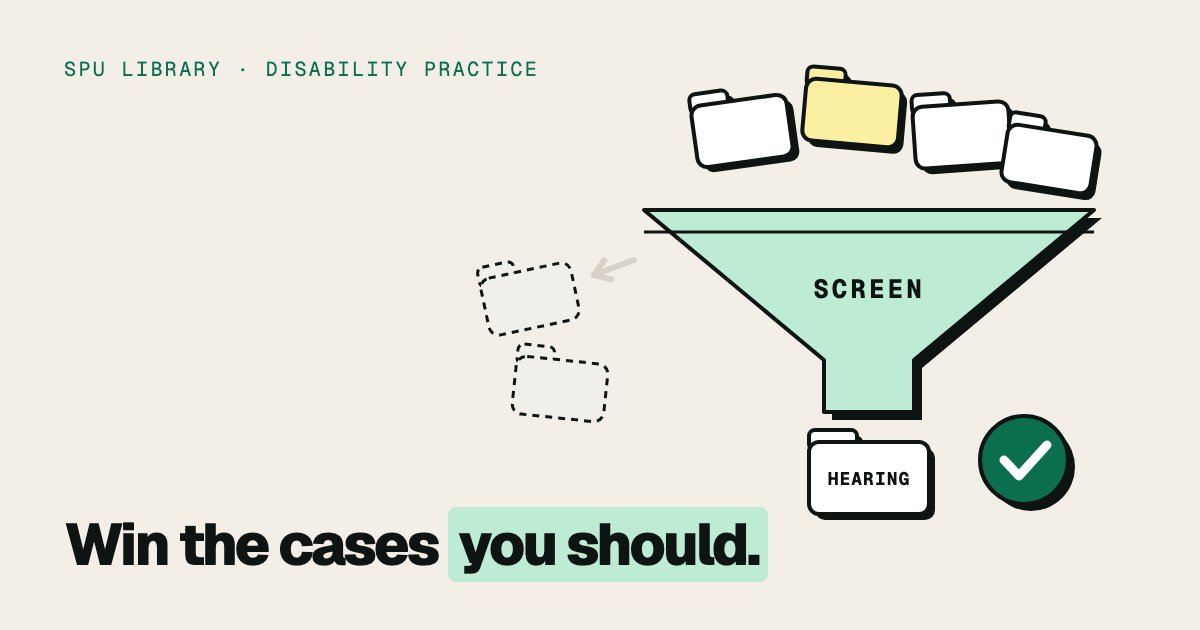
- For lawyers starting a Social Security disability practice, case selection is the business: screen carefully and win the cases you should.
- SSA approves representative fees, and fee agreements are capped at the lesser of 25% of past-due benefits or $9,200.
- AI can summarize records, flag treatment gaps and check work history, but the lawyer still judges the case and prepares the client.
For lawyers looking for a practice area with steady demand, Social Security disability work has an obvious appeal. But the fees are capped and approved by the government, so every case has to earn its keep. That makes it a business problem first. Solo Practice University's course on building a disability practice, taught from 2009 on, treated it that way. Its systems also show where AI now fits.
Case selection is the business model
The course, Creating A Social Security Disability Practice, was taught by Jonathan Ginsberg, and its first lesson put the hard part up front:
"As you enter this practice area, you must develop the skills to identify cases that can be won."
Sympathy isn't a case. The course pointed out that a claimant has to prove they meet Social Security's definition of disability, and the lawyer has to build "a cogent argument that will convince an experienced judge." Its answer to the client question "what percentage do you win?" was a lesson in how to think about volume:
"I respond by saying that I 'win' about 90% of the cases that should be approved."
That doesn't mean only taking sure things. The course argued for taking some "iffy" cases on purpose, like a younger claimant with a serious condition but thin medical support, because "These cases will make you a better lawyer, win or lose." But by 2011, with Congress scrutinizing disability awards and newer judges approving fewer claims where the instructor practiced, the advice tightened:
"…you should screen your cases carefully and do not accept every case that comes across your desk."
Screening starts with the theory of the case. The course taught three: the impairment meets or equals a "listing"; the client's functional capacity is so eroded that they couldn't reliably do even a simple, unskilled job; or the "grid rules" apply because of age, education and work history. Listing cases are often identified early, at the initial application or reconsideration, so the course said the functional capacity argument is the one you'll make most often before a judge. If none of the three fits, that's your answer at intake.
Three ways to argue a disability case
Saying no is a skill most new solos have to learn, and SPU has written about getting good cases for you, not just more of them. In a disability practice, a bad intake decision costs you months of file work.
Fees: what the course said, and what SSA says now
The course's written lessons said little about the fee schedule itself, and the rules have changed since it was taught, so here's the current version. Under SSA's fee agreement process, the Social Security Act limits the fee to the lesser of 25 percent of past-due benefits or a dollar cap. SSA raised that cap to $9,200 for favorable decisions issued on or after November 30, 2024, and a 2025 notice kept it there (SSA, Fee Agreements; Federal Register, May 6, 2025). SSA has to approve the fee, so check its site for the current figure before you sign anyone.
A capped fee changes the math: you can't bill your way out of a messy file. The course showed one way to protect your time. The instructor didn't write Appeals Council briefs, explaining "I do not have time to develop appellate advocacy skills while trying to manage a busy trial practice." Instead:
"I have found two very competent appellate lawyers who review my unfavorable decisions and I have worked out a deal with these lawyers to split the fees if the appeal is successful."
Fee splits between firms have their own rules, so check your own jurisdiction's rules. SPU's post on how to ethically share legal fees covers the general questions.
Intake and client communication
The course warned that the wait from application to hearing could exceed two years, so communication was built into the process. Intake came first. When SSA tightened its privacy rules, the instructor changed the intake form to collect the details SSA would ask for, such as the client's place of birth. A standard form per practice area pays off, as SPU's post on whether to use a client intake form argues.
Then came reminders. A client who changed banks during a two-year wait could lose a past-due check of "$20,000, $30,000 or more." The fix was a staff routine:
"This is why my paralegal always includes in our hearing reminder email a reminder to update bank account info."
And before every hearing came an in-person conference, ideally ten days to two weeks out, to prepare the client to testify with specifics. The course's example: not "I can't sit or stand very long," but "I can sit for 10 to 15 minutes then I need to stand up and walk around." It also had a dry view of the alternative: "Let the other lawyers look silly trying to identify clients that they have obviously never met with before."
Staffing: the worksheet and the flag
The course's core system was a short case summary. Every file got a two- or three-page worksheet with the key dates, a condensed medical history and the client's work history. The goal:
"Ideally, you should be able to walk into your hearing with your 3 page summary, the claim file CD provided by SSA and nothing else."
The worksheet also catches problems early, if someone is looking. The course told of a hearing adjourned because the file had no current medical records, and the instructor's verdict was blunt: "What should have happened was that my office should have flagged this case because there was no current medical." The rule that followed: when the hearing notice arrives, check the last treatment date, and "If you see that the last date of medical treatment was more than two or three months ago, get on the phone to find out if there are missing records."
That's a job for a trained paralegal with a checklist. If you're hiring your first one, SPU's guide to building a law firm team is a good place to start.
Where AI fits a high-volume practice
The course was taught in the era of CDs and paper files. Today SSA offers appointed representatives online access to claimants' electronic folders through its Appointed Representative Services (SSA, Appointed Representative Services; Federal Register, April 18, 2016). The records arrive digital, and digital records can go through AI tools.
The course's own systems map neatly onto AI work:
- The worksheet. AI can produce a first-draft medical chronology and summary from the exhibit file, for you to check against the records.
- The flag. It can surface the last treatment date in a file, so the two-or-three-month rule gets applied to every case, not just the ones someone remembers.
- The work history. One course exercise showed a case summary where the alleged onset date came years before the client stopped working. Cross-checking dates is the kind of tedious comparison AI handles well, and it's a surprise you want to find before the judge does.
- The brief. The course filed a pre-hearing brief "in just about every case." A summary of the record is a starting draft.
Two cautions. First, ABA Formal Opinion 512 notes that "GAI tools are only as good as their data and related infrastructure," and that "uncritical reliance on content created by a GAI tool can result in inaccurate legal advice to clients or misleading representations to courts and third parties." A missed record in an AI summary is still your missed record, the same discipline behind checking AI output before it's filed. The state of the files you give an AI tool matters too. Second, medical records are about as sensitive as client data gets. Check the vendor's data terms and your own jurisdiction's rules before you upload anything.
A disability file with AI in the loop
- AI drafts the medical chronologyYou check it against the records.
- AI surfaces the last treatment dateOver two or three months? Call about missing records.
- AI cross-checks work history and onset dateSurprises found before the judge finds them.
- You choose the theory and the casesScreening stays a lawyer's call.
- You prepare the client in personSpecific, honest testimony can't be automated.
What AI can't do is the part the course valued most. On judges, the instructor wrote: "There has to be some 'judgment' in judging - it should not be a mechanical process." The same goes for the lawyer. Deciding which case to take, which theory to lead with, and whether a client will come across as credible are judgment calls.
Retail practice is changing
John O'Connor, founder of Associate and SPU's Professor of AI Fluency, made a prediction about high-volume consumer practices in ten predictions for the legal industry:
"A new generation of AI savvy lawyers starts to dominate retail (injury, bankruptcy)."
Disability work isn't on that list, but it has the same profile: many clients, standard procedures, percentage fees and heavy records. O'Connor also expects pressure from above: "It pressures the BigLaw job market because those jobs will be automated away, that pushes a new type of attorney into the practice areas that had been dominated by solos." O'Connor's advice is to prepare now: "We need solo ants, not grasshoppers." In Aesop's fable, the ant stores food for winter while the grasshopper plays. For a disability practice, the stored-up work is the intake form, the worksheet template and the checklist.
The course had one more growth idea. When the instructor came across a rare condition, they wrote an article about winning disability cases for it, aiming to become the local expert. That's still how a niche gets found, though our post on legal blogging when AI can write a post explains why generic content no longer works. If those articles live on your firm's website, SPU offers a free law firm website review.
This post draws on a slice of the course. It also covered the three theories in depth, functional capacity forms from treating doctors, hearing reporters and vocational witnesses, mental health and back pain cases, and writing case studies. For more on practice tools, see our technology coverage.
Build your practice with SPU
SPU membership gets you the community, monthly strategy sessions and the course library, so you can build the intake, records and client systems a high-volume practice runs on.
Get one practical lesson for your firm every week.
Free, from practicing lawyers. Every issue includes a lesson from the archive. Unsubscribe anytime.
The SPU Team writes and edits Solo Practice University's articles. Susan Cartier Liebel founded SPU in 2009 to teach lawyers the practical side of building a practice, the part law school leaves out, with courses taught by practicing lawyers. Today SPU is a community for solo and small-firm lawyers, with an AI Fluency program for firms putting AI to work. Nothing here is legal advice: check your own jurisdiction's rules.
About Solo Practice University →