Hallucinated Citations: The New Malpractice Risk for Lawyers
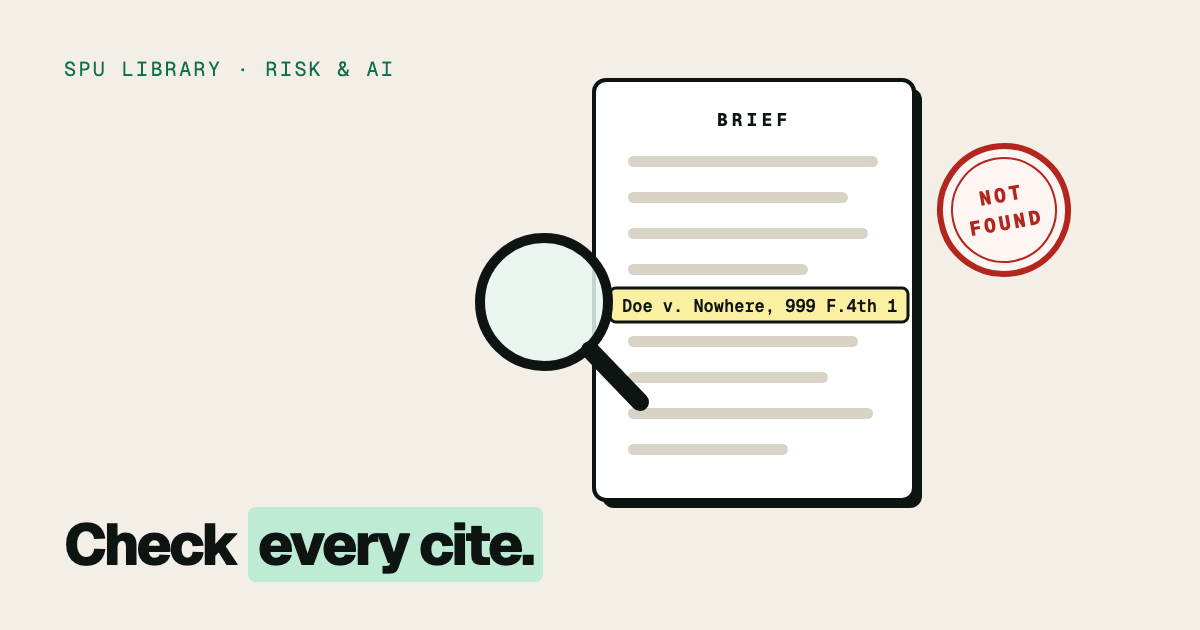
- For lawyers, a fake AI citation is an old malpractice failure: a routine check skipped, not missing knowledge.
- ABA Formal Opinion 512 warns some AI tools hallucinate, giving plausible responses with no basis in fact or reality.
- Verify every authority at the source, tell the client about errors early, and don't bill the client to fix them.
For lawyers, the newest malpractice risk looks a lot like the oldest one. A brief cites a case that doesn't exist, or quotes a holding the court never wrote, and nobody checks before it's filed. The cause isn't ignorance of the law. It's a routine step that got skipped because the draft looked right. Solo Practice University's legal malpractice course, taught long before generative AI, had the cure for that kind of error. It still works.
Plausible and wrong
The problem has a name now. ABA Formal Opinion 512, the ABA's July 2024 opinion on generative AI tools, puts it plainly:
"Some GAI tools are also prone to 'hallucinations,' providing ostensibly plausible responses that have no basis in fact or reality."
The word that matters is plausible. A hallucinated citation has a real-looking case name, a reporter, a page number and a year. It reads like every other citation in the brief. The opinion also notes that the tools "lack the ability to understand the meaning of the text they generate or evaluate its context." The tool isn't lying to you. It doesn't know the difference.
Courts have already shown what this costs. In Mata v. Avianca in 2023, a federal judge in Manhattan fined two lawyers and their firm $5,000 over a brief citing cases ChatGPT had made up (ABA Journal, LawNext). We covered that case in our post on the wastes AI adds to a law office. A few months later, in January 2024, the U.S. Court of Appeals for the Second Circuit referred a lawyer to its Grievance Panel in Park v. Kim. A reply brief had cited a state court decision that didn't exist, and the lawyer said ChatGPT had suggested it. The court also ordered the lawyer to give the client a copy of its ruling (Bloomberg Law, The Volokh Conspiracy, National Law Review).
Sanctions are the public cost. The private cost is the client, who now has a lawyer the court doesn't trust and an argument built on nothing. That's where a sanctions problem becomes a malpractice problem.
The errors were never about ignorance
SPU's course Prosecuting and Defending (and avoiding) Legal Malpractice Claims was taught by Brooks Schuelke, and it looked at lawyer error from the side of the claims that follow it. Its prevention lesson started with systems:
"Lawyers are required to know too much to simply keep information in our heads."
The instructor drew on Atul Gawande's The Checklist Manifesto, and summarized its premise this way: "many errors (including those in many legal malpractice cases) are not made because the professionals don't know something, but because we don't properly use or remember the information that we do know." Then came the line that fits the AI era almost too well:
"And it's not the difficult things that professionals tend to forget, it's the simple routine items that we all take for granted."
The course's examples were where a document needs to be filed, calendaring known deadlines, and a routine but necessary part of a pleading. Checking that a cited case exists belongs on that list. Every lawyer knows to do it. It's simple, routine, and easy to take for granted when the draft arrives looking finished.
Same failure, new source
Cognitive surrender is the new skipped step
Why do careful lawyers skip the check? Because the output is fluent, fast and confident, and reading every authority feels like redoing work the machine already did. John O'Connor, founder of Associate and SPU's Professor of AI Fluency, has a name for the habit:
"The lethal AI habit for lawyers is cognitive surrender of work product."
A hallucinated citation in a filed brief is what that surrender looks like on paper. The lawyer didn't decide the case was good law. The lawyer accepted that it was. O'Connor's advice on adoption is to use AI freely on the business side of the practice and sparingly on the core work. Research and briefing are the core work.
Opinion 512 makes the same point in ethics terms: "lawyers' uncritical reliance on content created by a GAI tool can result in inaccurate legal advice to clients or misleading representations to courts and third parties." Its headnote lists the duties in play, including the duty "to ensure candor toward the tribunal." What those duties require of you depends on where you practice, so check your own jurisdiction's rules and any standing orders from your judges.
Build the checklist the course asked for
The course didn't hand out a universal checklist. It asked lawyers to build their own:
"Consider where your practice area is vulnerable to an error or something dropping through the cracks, and then consider whether you can implement a checklist that will help you avoid that risk."
If you use AI for research or drafting, citations are now one of those places. A short, boring list works better than good intentions. Our older post on lists as an effectiveness tool makes the general case. For AI-assisted filings, the list might look like this:
- Pull every authority from the source. Open each case in the official reporter, the court's site or your research service. If you can't find it, it doesn't go in.
- Read it, don't skim it. Confirm the case says what the brief says it says, and that a quoted sentence appears in the opinion word for word.
- Check it's still good law. Run it through a citator, the same as any other authority.
- Don't let the tool grade itself. Asking the same chatbot whether its case is real isn't verification. The source is.
- Know who checked. If a contract lawyer or assistant did the research, you still sign. Decide in advance who verifies and how you'll know it happened.
The same goes for anything else AI writes in your name, from a demand letter to the practice-area pages on your firm's website. If AI drafted those pages, read them as closely as a brief. SPU offers a free law firm website review if you want another set of eyes on them.
Scope matters too. One lesson told lawyers to "clearly define who we do and don't represent." Apply the same discipline to the tool: write down what AI does in your practice and what it doesn't. A firm that never lets AI choose authorities has a much smaller verification problem than one that lets it do everything. The quality of what you feed it matters as well, but no input makes the checking optional.
Before an AI-assisted filing goes out
- Pull every authority from the sourceCan't find it? It doesn't go in.
- Read the case, not the summaryQuotes appear word for word.
- Confirm it's still good lawRun the citator as usual.
- Don't let the tool grade itselfThe source verifies, not the chatbot.
- Know who checkedYou sign, so you decide who verifies.
When something slips through anyway
Checklists reduce errors. They don't end them. The course was just as direct about what to do after a mistake, and it's the part of the old discipline AI makes more important, not less.
"As long as I've done legal malpractice work, I have always maintained that the best defense to a legal malpractice claim is an admission of the error and an apology."
The instructor had seen both ends: a lawyer who admitted the error and helped the client pursue the claim, and a lawyer who hid a missed filing until the clients found out at the courthouse. The second was the harder case to resolve. SPU has written before about how saying "I'm sorry" helps client relations, and about why you should stop digging once you've made a mistake. If a fake citation reaches a court, the client shouldn't hear about it from the judge first.
The course also warned against charging for the cleanup:
"On the other hand, when you conceal your error or charge your client for the time spent fixing the error, you're just begging to be sued."
This lines up with how Opinion 512 treats AI time. Its fee example says a lawyer who bills hourly and uses AI to draft a pleading may charge for the input time "as well as for the time the lawyer expends to review the resulting draft for accuracy and completeness." Review is part of the work. Responding to a show-cause order because a hallucinated case got through is fixing your own error, and in the course's view that's not something to put on the client's bill. Fee rules vary, so check your own jurisdiction's rules, and know what your malpractice insurance expects you to report and when.
The old discipline, applied to a new tool
None of this argues against AI. It argues against signing what you haven't read. The course's habits were systems over memory, checklists built around your own weak spots, defined scope, admitting errors early and not billing to fix them. Each one maps onto AI work without changes. For more on the rules side, see our guest lecture on the ethics of using AI, or browse our technology coverage.
This post draws on a slice of the course. It also covered the law of malpractice claims (duty, the standard of care, causation and the "case within a case"), breach of fiduciary duty, liability to non-clients, risks specific to solos and office sharing, why suing clients for fees invites counterclaims, planning for emergencies, and an interview on defending claims.
Keep learning with SPU
SPU membership gets you the community, monthly strategy sessions and the course library, so you can build AI habits that protect your clients and your license.
Get one practical lesson for your firm every week.
Free, from practicing lawyers. Every issue includes a lesson from the archive. Unsubscribe anytime.
The SPU Team writes and edits Solo Practice University's articles. Susan Cartier Liebel founded SPU in 2009 to teach lawyers the practical side of building a practice, the part law school leaves out, with courses taught by practicing lawyers. Today SPU is a community for solo and small-firm lawyers, with an AI Fluency program for firms putting AI to work. Nothing here is legal advice: check your own jurisdiction's rules.
About Solo Practice University →