AI Intake for Lawyers: Who's the Client, and for What?
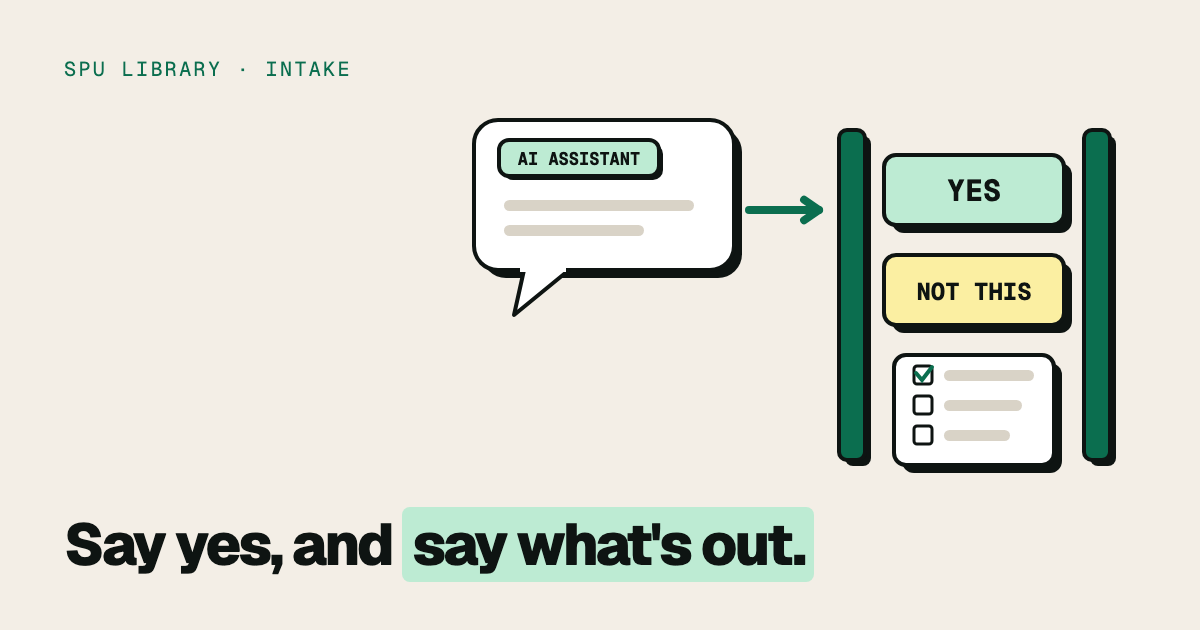
- For lawyers, online and AI-assisted intake must still settle two things early: who the client is, and what you will do.
- Florida's AI opinion warns intake chatbots can create a prospective or actual client relationship without the lawyer knowing.
- Let AI gather facts and schedule; keep conflicts, scope, acceptance and declining with the lawyer, and check your jurisdiction's rules.
For lawyers, the client relationship now often starts before anyone at the firm says a word. A form gets filled in at midnight, a chat window answers questions, a fee gets paid online. AI makes that front door faster and friendlier. It also makes it easier to skip the two questions intake exists to answer: who is the client, and what exactly have you agreed to do?
The course built intake around those two questions
Solo Practice University's Virtual Law Practice course taught lawyers to take on clients online starting in 2008, when that was still unusual. Its lesson on scope began with a sequence that still holds. Stephanie Kimbro, who taught the course, wrote in 2009:
"The next step after establishing the attorney/client relationship is to define the scope of the legal representation and to provide the client with notice regarding the terms and conditions of the representation and the way that he or she will be charged for legal services."
The course's online version of the engagement letter had a set order. The lawyer sent a personal note through the secure portal covering the scope and billing for this particular matter. The client got that note along with the firm's standard clickwrap terms and had to click to accept both. Some lawyers also required a signed engagement letter, uploaded back to the portal, before starting work. Only then did the lawyer proceed.
Identity came first. A family law practitioner who wrote a 2009 guest lesson for the course described running intake entirely through registration: "I insist that potential clients register online before they talk to me." Then:
"The first thing I do when a potential client registers online is verify that there are no conflicts of interest."
If there was a conflict, the person got a polite message saying the lawyer couldn't help, and no conversation happened. That's a non-engagement notice, sent before any legal advice could be given. SPU's archive explains why non-engagement letters have their place.
The course's online engagement sequence
Clickwrap: notice, a chance to read, and a click
The course spent a full lesson on clickwrap agreements, and the principle behind them is simple. The client has to know the terms exist, get a real chance to read them, understand that clicking means agreeing, and then actually click. When it was taught, the course cited an ABA cyberspace law panel for those points and said courts had come to accept clickwrap as an enforceable contract form. Whether a clickwrap engagement would hold up for you today is a question for your own jurisdiction's contract law and ethics rules, not this post.
The more durable advice was about what the terms had to say. The course's list for a virtual office's terms ran ten items, including the jurisdictions where the lawyer is licensed, what unbundled services are, when and how the relationship and its scope get defined, and confidentiality. One line covered every inquiry:
"The virtual attorney should take care to define the scope of legal representation (or clearly decline representation) with each individual client who contacts the attorney through the VLO interface."
Define it or decline it. There's no third option where a person who filled in your form is left guessing whether you're their lawyer.
Unbundled means saying what you won't do
Much of the online work the course described was unbundled: the lawyer drafts or advises, and the client handles the rest. That only works if the limits are clear. The current ABA Model Rule 1.2(c) reads: "A lawyer may limit the scope of the representation if the limitation is reasonable under the circumstances and the client gives informed consent" (ABA state-by-state comparison; ALPS on limited scope). States vary, and some require the consent to be confirmed in writing, so check your own jurisdiction's rules. SPU's archive covers why limited scope is no time to play fast and loose.
The course pointed students to North Carolina's 2005 Formal Ethics Opinion 10, "Virtual Law Practice and Unbundled Legal Services." It is still on the North Carolina State Bar's list of adopted opinions, and the Bar's 2024 AI opinion cites it. On scope, it says that before taking on the work, lawyers "must disclose exactly how the representation will be limited and what services will not be performed." It also says that if a limited service won't be enough to represent the client competently, the lawyer must tell the client and decline to provide only the limited service.
The course made the same call on competence: "If it is necessary for the legal service requested, then it is the responsibility of the attorney to speak with them by phone or refer them to a full-service law practice." A menu of services on a website doesn't decide whether a matter fits the menu. The lawyer does.
Where AI belongs in intake
The course's advice for lawyers easing into online delivery was to start with the administrative side: "Start with a secure online client intake form for use with prospective clients." That's still the right place for AI. John O'Connor, founder of Associate and SPU's Professor of AI Fluency, draws the same line:
"Use AI to delegate everything around the practice, the business side."
In intake, that means gathering basic facts, collecting names of other parties for the conflict check, answering questions about process and fees from text you've approved, scheduling, and drafting the summary you read before the consultation. Our post on using a client intake form covers the form itself, and mapping the process first helps you decide which steps a tool should touch.
The guardrails for an AI intake assistant
The risk is that a friendly chatbot does more than intake. Florida's Opinion 24-1 on generative AI, approved January 19, 2024, addresses intake chatbots directly. It says they present additional risks, "including that a prospective client relationship or even a lawyer-client relationship has been created without the lawyer's knowledge." It also says:
"To avoid confusion or deception, a lawyer must inform prospective clients that they are communicating with an AI program and not with a lawyer or law firm employee."
The opinion adds that the lawyer is ultimately responsible if the chatbot gives prospective clients misleading information (LawNext's summary covers the same points). That's Florida's advisory guidance. Your bar may say something different, or nothing yet.
People who consult you about possible representation are owed duties too. Under ABA Model Rule 1.18, lawyers owe confidentiality to prospective clients, not only to current and former ones, and ABA Formal Opinion 492 advises warning prospective clients against sharing detailed information at an initial consultation, because the more you learn, the more likely it can later disqualify you (ABA Journal; NWLawyer). An AI assistant that asks open-ended questions and encourages people to tell their whole story works against that.
Confirming who the client is matters more when nobody sees a face. North Carolina's 2005 opinion listed "creating a client-lawyer relationship with a person the lawyer does not intend to represent" among the pitfalls of online practice. Intake should establish whose matter it is, who the other parties are, and whether the person typing is the person who would be the client. Those answers feed the conflict check, and a human should confirm them.
Splitting the intake work
Your website is where most of this happens, so look at it the way a prospective client would. Does the chat window say what it is? Does the form promise anything you haven't agreed to? SPU offers a free law firm website review if you want a second opinion.
Close every loop in writing
The course treated engagement as something you revisit. If a matter got more complex than the original scope, the lawyer had to "renegotiate the terms of the representation, make these new terms clear to the online client and receive acceptance from the client in order to continue with the legal matter under these new terms." The same applies at the end. In North Carolina's 2005 opinion, the sample limited-scope agreement told the client the firm would not be monitoring the status of the case. An unbundled client needs to know when your part is done.
So intake produces one of three written results: an engagement with a defined scope, an amendment when the scope changes, or a clear decline. AI can draft any of them. The lawyer decides which one goes out. SPU's archive explains why engagement letters aren't optional, and how to decline engagements with grace.
What else the course covered
This post draws on the course's lessons on scope, clickwrap and unbundling. Virtual Law Practice also covered state bar opinions on cloud computing, choosing a provider, security and encryption, competence with limited client contact, marketing and the virtual office website, payment processing, and hybrid practices that add online delivery to a traditional office. For more on working with clients, see our client relations archive.
Build your intake with other solos
SPU membership gets you the community, monthly strategy sessions and the course library, with other lawyers working out how far to let AI into their intake. Join SPU.
Get one practical lesson for your firm every week.
Free, from practicing lawyers. Every issue includes a lesson from the archive. Unsubscribe anytime.
The SPU Team writes and edits Solo Practice University's articles. Susan Cartier Liebel founded SPU in 2009 to teach lawyers the practical side of building a practice, the part law school leaves out, with courses taught by practicing lawyers. Today SPU is a community for solo and small-firm lawyers, with an AI Fluency program for firms putting AI to work. Nothing here is legal advice: check your own jurisdiction's rules.
About Solo Practice University →