Defending a Deposition: How Lawyers Prepare Their Witness
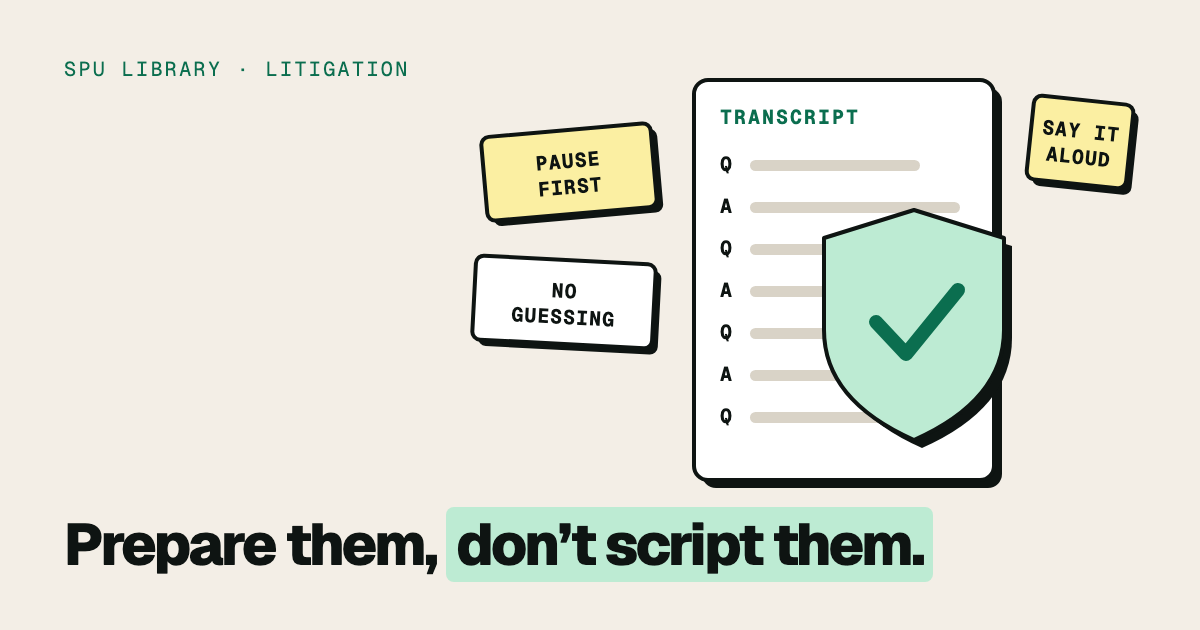
- For lawyers defending a deposition, the work is mostly done before it starts: teach the ground rules and rehearse the hard questions.
- Prepare the witness to tell the truth in their own words. A witness drilled into scripted certainty can be boxed in later.
- Check current objection and conference rules in your court, and have the witness review the transcript itself, not an AI summary.
Most deposition advice for lawyers is about taking one. The deposition you defend gets less attention, even though it's often your own client in the chair, nervous, under oath, being questioned by someone paid to find the weak spot. AI can now summarize the transcript afterward. It can't sit beside your witness. The work that protects them happens before anyone is sworn in.
The other side of the table
In 2009, Solo Practice University ran The Art of the Deposition, taught by Victoria Pynchon. SPU has already covered its method for asking questions, the funnel technique for deposition questions. This post is about the other chair. The course had a short lesson called "Eight Tips for Defending a Deposition," and its first tip sets the agenda:
"Prepare your witness for all difficult questions you anticipate will be asked and rehearse the responses."
Rehearse is the key word. Telling a client "just tell the truth" and sending them in isn't preparation. Most witnesses have never seen a deposition. Many walk in with ideas about their case that don't survive the first hour, and SPU's archive has a whole list of the misconceptions clients have about their cases. A client who knows what each step will look like isn't blindsided, a point SPU made years ago about breaking a case into phases for the client.
Teach the ground rules before the other lawyer does
Every deposition opens with the examining lawyer's "ground rules." The course reproduced a full set from a real transcript, and they make a good prep script in reverse: everything the other side will tell your witness, your witness should hear from you first.
Some rules are about the record. The witness should wait for the whole question before answering. The transcript gave two reasons: the court reporter can take down only one person at a time, and lawyers sometimes start a question one way and end it with a negative, so an early "yes" becomes the wrong answer. Nods and "uh-huhs" don't make it into the transcript, so answers have to be said out loud.
Others are about honesty. "I don't know" and "I don't remember" are acceptable answers. And there's a line between estimating and guessing that witnesses rarely understand. The course's checklist told the examiner to explain that "you are entitled to the witness' best testimony, including her estimates of duration, size and the like, but not guesses." The transcript's example: a witness can estimate the length of the table they're sitting at, but anything they say about the length of a dining table in a house they've never visited is a guess.
The course was also honest about nerves, on both sides of the table. In one recorded lesson, the instructor admitted to talking too much while giving the admonitions, out of anxiety, and noted:
"The admonition stage gives you the opportunity to calm your own and the deponent's nerves."
If you're defending, use your prep session for the same purpose. Walk through the rules, then ask practice questions until the witness pauses before answering without being reminded.
What your witness should hear from you first
- Wait for the whole questionIt may end with a negative
- Answer out loudNods don't make the transcript
- Estimates, yes. Guesses, no.The table you're at versus one you've never seen
- "I don't know" is an answerSo is "I don't remember"
- Ask when a question is unclearOtherwise the answer counts
Prepare, don't script
The course spent several lessons on scenes from the film The Verdict. In one, a defense lawyer rehearses a physician for testimony, pushing for short, confident answers and plainer words. Later in the film, the physician's certainty is used against them. The instructor described it as the plaintiff's lawyer "leading the defendant physician into the box canyon of his own certainty."
That's the risk in over-preparing. A witness rehearsed into sounding certain about everything has nowhere to go when a document contradicts them. A witness prepared to tell the truth in their own words, including "I don't know," is much harder to corner.
AI can help with the rehearsal, if you keep it in its place. A general assistant like ChatGPT or Claude can turn your own notes into a plain-language handout of the ground rules, or suggest the hard questions an opponent might ask about a timeline you describe. Then you do the rehearsal, live, and you listen to how the witness actually answers. Before you put any client information into a tool, check the vendor's data terms and your own jurisdiction's rules.
Practice matters here for the lawyer too. If you're newer to litigation, or covering appearances for other firms, you may be defending witnesses you met that morning. That's when a written prep checklist earns its keep.
Objections: what the course taught, and what the rules say now
The lesson on defending depositions also covered objections, and here the 2009 material needs a careful update. Some of it lines up with today's federal rule. Some of it doesn't.
The course warned: "Never instruct as to 'relevance,' even when relevance is the basis for your instruction." Federal Rule of Civil Procedure 30(c)(2) now puts it in black letter. "A person may instruct a deponent not to answer only when necessary to preserve a privilege, to enforce a limitation ordered by the court, or to present a motion under Rule 30(d)(3)." The same rule says an objection "must be stated concisely in a nonargumentative and nonsuggestive manner" (Rule 30, Cornell LII; Federal Rules of Civil Procedure, U.S. Courts). The 1993 committee note explains why: depositions had been prolonged "by lengthy objections and colloquy, often suggesting how the deponent should respond."
The course also said to "Make all objections as to form or they are waived." Under federal Rule 32(d)(3)(B), an objection to the form of a question is waived if it isn't timely made during the deposition (Rule 32, Cornell LII; same U.S. Courts PDF).
Two of the course's tips need more caution. One told students to explain "the ways in which objections can serve as signals that the question is too speculative or confusing to answer." That sits uneasily with a rule that requires nonsuggestive objections. Another said: "Assure your witness he can consult you at any time, whether a question is pending or not." Some courts now say otherwise. In the federal Southern and Eastern Districts of New York, for example, Local Civil Rule 30.4 says "An attorney for a deponent must not initiate a private conference with the deponent while a deposition question is pending, except for the purpose of determining whether a privilege should be asserted" (S.D.N.Y. and E.D.N.Y. Local Rules, 2026; E.D.N.Y. Local Rules, 2025).
State courts have their own rules, and judges have their own standing orders. The course said the same about closing stipulations: "you should check your own state or federal rules." Check your own jurisdiction's rules before you prepare a witness for what objections will and won't mean.
The course in 2009, the rules now
One more lesson your witness should hear. In the course's opening story, a new lawyer rephrased questions dozens of times after objections, until a senior defense lawyer pulled them aside at lunch: "Just wait for the answer… You don't need to re-phrase the question." In most depositions, an objection is noted on the record and the witness still answers. Rule 30(c)(2) says the examination "still proceeds." Tell your witness that before the first objection, so it doesn't rattle them.
After the deposition: the transcript, not the summary
The ground rules in the course warned witnesses that they could read and correct the transcript, but that a significant change could be embarrassing. That still applies. Under federal Rule 30(e)(1), if the deponent or a party asks before the deposition is completed, the deponent gets 30 days after being notified that the transcript is available to review it and sign a statement listing any changes and the reasons for them (Cornell LII; U.S. Courts PDF).
This is where AI tempts. A summary of a long transcript is useful for your own case planning. It's the wrong thing to hand a witness doing that review. A summary can smooth over a hedge, merge two answers, or drop the objections you'll need at trial. ABA Formal Opinion 512 warns that generative AI tools "lack the ability to understand the meaning of the text they generate or evaluate its context," and that "uncritical reliance on content created by a GAI tool can result in inaccurate legal advice to clients or misleading representations to courts and third parties." SPU covered what that looks like in practice in hallucinated citations and malpractice risk.
So use the summary to find your way around, and check every point you rely on against the page and line. Have the witness read the transcript itself. The transcript is what gets signed.
What else the course covered
Defending was one lesson in a long course. The Art of the Deposition also covered using documents, authentication and the business records exception, impeachment, questions every examiner should ask, expert witness outlines, designee depositions, and role plays built around a shared case file. For more on working with clients, see SPU's client relations articles. Litigation clients often check your website before they call, so make sure it explains how you prepare them. SPU offers a free law firm website review.
Prepare with other litigators
SPU membership gets you the community, monthly strategy sessions and the course library. Bring your witness prep checklist and compare it with how other solo and small-firm litigators do theirs.
Get one practical lesson for your firm every week.
Free, from practicing lawyers. Every issue includes a lesson from the archive. Unsubscribe anytime.
The SPU Team writes and edits Solo Practice University's articles. Susan Cartier Liebel founded SPU in 2009 to teach lawyers the practical side of building a practice, the part law school leaves out, with courses taught by practicing lawyers. Today SPU is a community for solo and small-firm lawyers, with an AI Fluency program for firms putting AI to work. Nothing here is legal advice: check your own jurisdiction's rules.
About Solo Practice University →