The Cloud Opinions Already Told Lawyers How to Vet AI
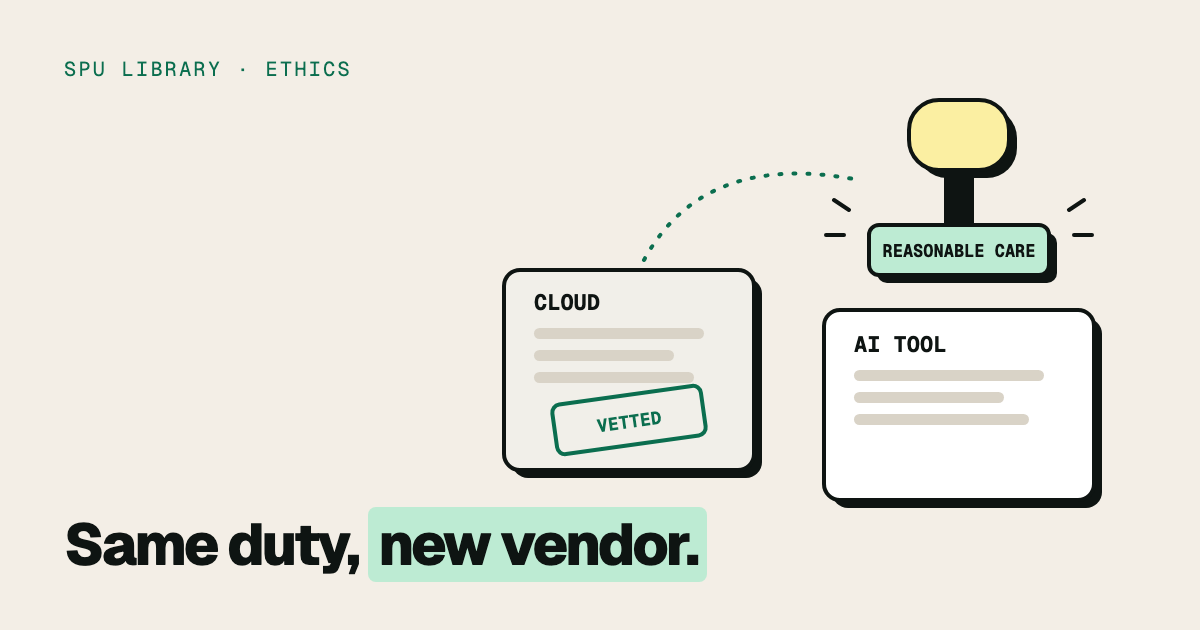
- For lawyers, the state bar cloud computing opinions of the 2010s already answer most questions about AI vendors and client data.
- North Carolina and Florida have said their cloud guidance is equally applicable to AI tools that handle confidential client information.
- What's new is training and retention: find out whether a tool keeps or learns from what you type, and check your jurisdiction.
Lawyers asking whether an AI tool is safe for client data are asking a question the profession has answered before. When practice moved to the cloud, state bars spent years working out what a lawyer owes clients when their files sit on someone else's servers. Two bars have now said, in writing, that those answers apply to AI. If you know the cloud opinions, you already know most of the AI rules.
The course watched the opinions arrive
Solo Practice University's Virtual Law Practice course ran from 2008 into 2014, and it tracked the bar opinions as they came out. That was a large part of the job. In a January 2012 update, Stephanie Kimbro, who taught the course, put the problem this way:
"Not only do we have to keep up with the changing technology and security risks but we also have to keep a close eye on the way that regulators may be adopting rules that will impact our use of technology to deliver legal services online."
The list that followed is history now, but it shows how fast the ground was moving. When it was taught, the course listed more than 30 opinions from 20 states, sorted into two groups: opinions on delivering legal services online, and opinions on storing client data electronically with a third party, the "SaaS and other forms of cloud computing" question. Several were brand new or still in draft. Three years earlier, a 2009 lesson had noted that "only recently" had bars begun to look past email and document-selling websites to online storage and software as a service.
Some of those opinions have since been revised, replaced or overtaken by rule changes, so don't treat the course's list as a current map. Treat it as the record of how the reasoning was built. (We covered the course's practical security lessons, including its vendor questions, in virtual practice and security. This post is about the ethics opinions behind them.)
What the cloud opinions actually said
The bars mostly declined to write technical rules. They wrote a standard and a set of questions. The course was watching one of those opinions in draft in 2010, North Carolina's, and said of it: "The proposed NC State Bar opinion is great as a starting point, but does not provide guidance beyond the questions to ask."
That opinion was adopted on January 27, 2012, as 2011 Formal Ethics Opinion 6. Asked whether a law firm may use software as a service, it answered: "Yes, provided steps are taken to minimize the risk of inadvertent or unauthorized disclosure of confidential client information and to protect client property, including the information in a client's file, from risk of loss." The opinion then listed things to look at, such as how the vendor will handle confidential information and how the firm gets its data back if the service ends.
Florida took the same route. Its 2024 AI opinion summarizes its earlier cloud computing opinion, 12-3, as concluding that a lawyer should:
"Ensure that the provider has an obligation to preserve the confidentiality and security of information, that the obligation is enforceable, and that the provider will notify the lawyer in the event of a breach or service of process requiring the production of client information…"
The same passage adds two more steps: investigate the provider's reputation, security measures and policies, including limits on its liability, and find out whether the provider keeps your data after you leave or claims rights to it. One detail ties it back to the course. Florida's cloud opinion relied on New York State Bar Opinion 842 and Iowa Ethics Opinion 11-01, and both appear on the course's 2012 list.
One line of reasoning, two technologies
Two bars said it out loud
You don't have to draw the analogy yourself. North Carolina's 2024 Formal Ethics Opinion 1, adopted November 1, 2024, calls putting client information into an AI program "akin to any lawyer providing confidential information to a third-party software program (practice management, cloud storage, etc.), on which the Ethics Committee has previously opined." It walks through the considerations from 2011 FEO 6 and concludes that they "are equally applicable to a lawyer's selection and use of a third party company's AI service/program." (Lawyers Mutual's summary covers the opinion for North Carolina lawyers.)
Florida's Opinion 24-1, approved by the Bar's Board of Governors on January 19, 2024, is just as direct:
"While the opinions were developed to address cloud computing, these recommendations are equally applicable to a lawyer's use of third-party generative AI when dealing with confidential information."
(LawNext's report on the opinion notes the same point.) Florida's opinions are advisory, not binding, and both opinions are state guidance, not national rules.
At the national level, ABA Formal Opinion 512 (July 2024) lists the duties lawyers must consider when using generative AI, among them the duty "to protect client information." A footnote makes the continuity point: "Many of the professional responsibility concerns that arise with GAI tools are similar to the issues that exist with other AI tools and should be considered by lawyers using such technology." The opinion also calls the tools "a moving target" and expects state and local bar ethics committees to "offer updated guidance." Expect more opinions, and check your own jurisdiction's rules before relying on any of them.
What's actually new: the tool may learn from you
A cloud storage vendor holds your files. Some AI tools do something a filing cabinet never did: they keep what you type and use it to improve the product. North Carolina's opinion flags exactly that:
"Importantly, some current AI programs are publicly available to all consumers/users, and the nature of the AI program is to retain and train itself based on the information provided by any user of its program."
Its practical conclusion is blunt: "Generally, and as of the date of this opinion, lawyers should avoid inputting client-specific information into publicly available AI resources." Florida goes a step further on consent. Its opinion recommends getting the client's informed consent before using a third-party generative AI program if that use would involve disclosing confidential information (The Florida Bar News reported the same recommendation).
This is where the course's old standard, that only the attorney and the client should be able to see confidential information, meets its hardest test. A tool that trains on your prompts fails it by design. A tool with contract terms that rule out training and limit retention may pass. You find out which one you have by reading the terms, not the marketing page. If you're unsure what a tool does with your data, our post on the files you give an AI tool is a good companion read.
The cloud questions, asked of an AI vendor
Put the two bars' lists together and you get a short set of questions for any AI tool that will touch client information. These are drawn from the opinions above. They aren't a safe harbor, and your bar may ask for more.
- Is confidentiality a promise or a feature? Look for an enforceable obligation in the terms to protect your information, and a duty to tell you about a breach or a subpoena.
- Who is the vendor? Reputation, stability, security measures and any cap on its liability.
- Does it keep or learn from what you enter? Retention before and after you cancel, any claim of rights to your data, and whether inputs train the model.
- Can you get it back, or get it destroyed? North Carolina asks what happens to your data if the company folds, changes owners or you end the service.
- Are you still checking? The cloud opinion expected lawyers to keep learning and adjust, "including abandonment, if necessary," when a service stops looking secure.
What the bars ask of any vendor
- An enforceable confidentiality promisePlus notice of a breach or subpoena
- A vendor you've looked intoReputation, security, liability limits
- No surprise retention or trainingBefore and after you cancel
- A way to retrieve or destroy dataIf the company folds or you leave
- A second look over timeAdjust, or abandon the tool
Don't forget the vendors you already have. A chat widget or a third-party form on your firm's website collects information from people who may become clients, and the same questions apply to it. If you haven't looked at your site with that in mind, SPU offers a free law firm website review.
The decision still belongs to the lawyer
The bars' approach, a standard plus questions, puts the judgment on you. The course said the same about virtual practice. Getting ready to present to the ABA's Ethics 20/20 Commission in 2010, the instructor wrote that there were "so few differences in the malpractice and ethics risks" between a virtual office and a traditional one:
"…in the end it comes down to the individual responsibility of the attorney operating the practice to make educated and ethical decisions about what services they can and cannot competently handle online."
Swap "online" for "with AI" and the sentence still works. No bar opinion will approve a specific tool for you. What they give you is a duty to protect client information, the questions to ask, and the expectation that you'll walk away from a tool that can't answer them. SPU's archive has more on data security due diligence, and on the other big AI risk, signing output you haven't checked. For background on the rules, see our guest lecture on the ethics of using AI.
What else the course covered
This post draws on the course's ethics-opinion lessons. Virtual Law Practice also covered choosing a cloud provider, security and encryption, clickwrap agreements and engagement terms, unbundled legal services, competence with limited client contact, marketing a virtual office, the bona fide office debate, and hybrid models that add online delivery to a traditional practice. For more on practice tools and risk, browse our technology coverage.
Work through the questions with other solos
SPU membership gets you the community, monthly strategy sessions and the course library, with other lawyers deciding which AI tools belong in their practices and which don't. Join SPU.
Get one practical lesson for your firm every week.
Free, from practicing lawyers. Every issue includes a lesson from the archive. Unsubscribe anytime.
The SPU Team writes and edits Solo Practice University's articles. Susan Cartier Liebel founded SPU in 2009 to teach lawyers the practical side of building a practice, the part law school leaves out, with courses taught by practicing lawyers. Today SPU is a community for solo and small-firm lawyers, with an AI Fluency program for firms putting AI to work. Nothing here is legal advice: check your own jurisdiction's rules.
About Solo Practice University →