Kaizen for Lawyers: One Small AI Fix a Week
- For lawyers and small law firms, AI adoption works better as one small, measured fix a week than as a big-bang rollout.
- Run each fix through Plan, Do, Study, Adjust: predict the result, try it on a few matters, then keep or change it.
- Start on the business side of the practice, like intake and billing, and keep your own thinking on the legal work.
Most lawyers who try AI try it the way they try a new gym routine: all at once, on a Monday, with big plans. By Thursday the subscription is still running and nobody is using it. There's an older, quieter method for changing how a law firm works, and it suits AI better than any rollout plan. It's called Kaizen, and Solo Practice University taught it to solos a decade before ChatGPT existed.
Why the big AI rollout stalls
The course is Lean Six Sigma for Solos, recorded for SPU between 2013 and 2015 and taught by Nora Riva Bergman and Liz Lamar. Its class on Kaizen drew a line between two ways to change a business. One is innovation:
"Innovation refers to dramatic sweeping change."
The course didn't knock innovation. Sometimes it's the only answer, as in a crisis, when small steps won't get the job done. But it explained why sweeping change so often falls short: "our brains, our human brains are built to resist massive change, which is what innovation is all about." The example was the "go to the gym every morning at 6 a.m." plan most of us have tried and dropped within days.
A firm-wide AI rollout is that gym plan. New tools for drafting, research, intake and billing, all at once, with no baseline and no way to tell what worked. Adoption is still uneven. In the ABA's 2024 Legal Technology Survey Report, 30% of responding lawyers said they used AI tools, but only 18% of solo attorneys did (ABA Journal, LawNext). If you're a solo who hasn't started, you don't need a bigger plan. You need a smaller one.
Kaizen: one small thing, then another
Kaizen, the course explained, literally means "good change." The Kaizen version of getting in shape doesn't start with a 6 a.m. alarm. It starts with a question: "what is one small thing I could do every day that would help me become healthier?" Maybe a 10-minute walk. Once that's a habit, you ask again, and the bar goes up a little.
"Kaizen's small changes really don't feel like changes at all, and that's why they work."
The course opened that class with a line from Harvard Business School's Theodore Levitt that sums it up: sustained success comes from "making a lot of uncelebrated little improvements every day." Uncelebrated is the key word. Nobody throws a party because the consult-confirmation email now drafts itself. But fifty of those fixes add up, the same way small choices compound in a career.
The course's habit for building a Kaizen culture was five words on a sticky note:
"…get in the habit of asking the question, is there a better way? Just those five words. Write them on a sticky note."
For a lawyer adopting AI, that's the whole strategy in one question. Not "how do we roll out AI?" but "is there a better way to do this one task, and could AI be part of it?"
Two ways to bring AI into a law firm
The weekly loop: Plan, Do, Study, Adjust
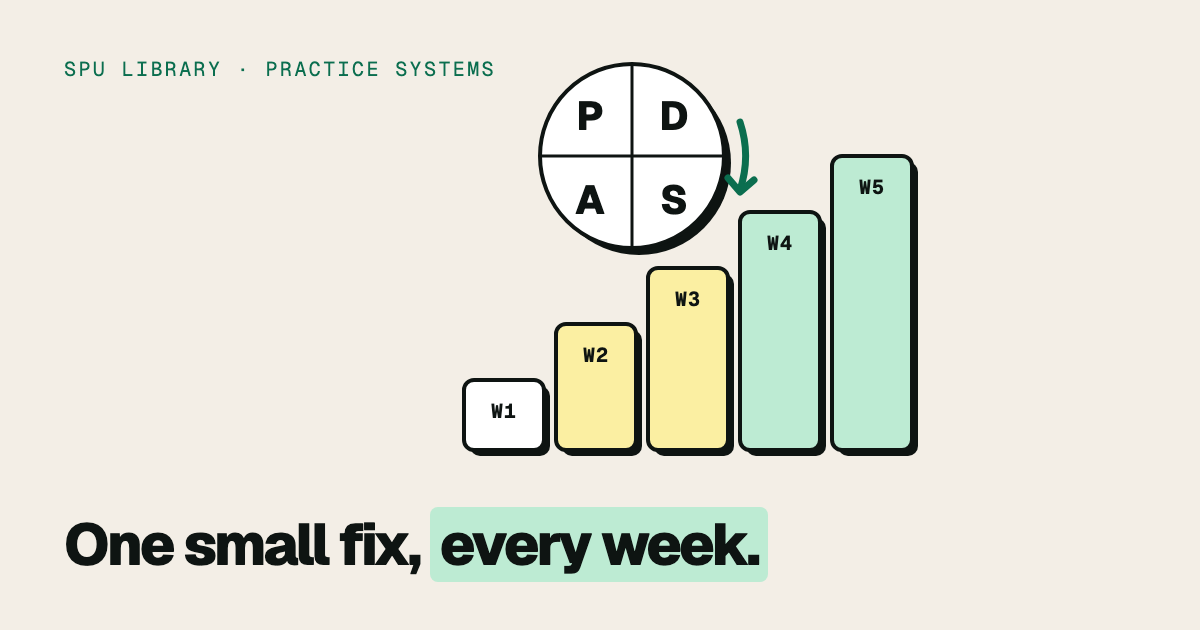
Kaizen is a mindset. The course paired it with a method: the PDSA cycle, Plan, Do, Study, Act, which it credited to W. Edwards Deming. Here's how one turn of the cycle looks with an AI fix on the business side.
Plan. Pick one process and fence it in. The course was firm about scope: if you're fixing filing, don't drift into how calls are answered. Say you want AI to draft the follow-up email after an initial consultation. Write down what you expect to happen, and how you'll measure it. The course explained why the prediction matters:
"It's important to predict the outcome because when you finish this cycle, you're going to measure results against what you thought your results might be."
"It'll save time" isn't a prediction. "Follow-ups go out the same day instead of two days later" is.
Do. Run it, but small. The course said to "try it on a small scale," and its own example was a less-paper filing system tried on maybe five clients or five matters, so the results could be compared against files handled the old way. Use the AI-drafted follow-up for the next five consultations, not all of them. Note problems and anything unexpected.
Study. Compare what happened with what you predicted. Did the emails go out faster? How long did you spend correcting each draft? Did one client get a detail wrong because the intake notes were thin? That last one is a finding too. It usually points to the notes, not the tool.
Adjust. Decide what to keep, change or drop. The course's Kaizen class swapped "Act" for "Adjust," crediting Karen Martin, author of The Outstanding Organization, for the change. The reason was simple:
"When you think of the word act, it's finite."
Adjust never finishes. Once the follow-up email works, the next cycle starts from that higher point. In the course's words, "the key to the PDSA cycle is that you repeat it. It's never ending."
The course also gave first-timers a rule worth following with AI: "Make it easy, go for a win, go for something you know you can improve, and keep the scale small so that you can be successful your first time out." Your first AI fix should be boring and likely to work.
Start on the business side
Where do the first fixes go? John O'Connor, founder of Associate and SPU's Professor of AI Fluency, draws the line clearly:
"Use AI to delegate everything around the practice, the business side."
That's the part of the firm SPU has long argued solos neglect when managing the business side, and it's where a weekly fix pays off fastest, because the tasks repeat. A few candidates, one per week:
- A first draft of the post-consultation follow-up email.
- A summary of intake notes into the fields of your intake form.
- A polite reminder for invoices more than 30 days old.
- Plain-language answers to the questions new clients ask every time.
- A fresh look at the copy on your contact page.
That last one is a good early win, because your website is the front door of intake. SPU offers a free law firm website review if you want a second opinion before you start changing it.
The other half of O'Connor's advice matters as much: "Use AI sparingly where it is corrosive to focus and attention span." Kaizen on the business side frees time. It isn't meant to hand over the legal thinking. Before you put client information into any tool, check the vendor's data terms and your own jurisdiction's rules.
Your checklist is your starting line
The course made a point about "standard work" that fits AI almost too well. Standard work is the current best way of doing a task, written down, often as a checklist:
"It simply provides the starting point from which to improve."
In an AI setup, the standard work is your prompt, your template and the notes that tell the tool how your firm does things. Each PDSA cycle improves it a little, and the improved version becomes the new standard. The course described standard work as a wedge that keeps the wheel from rolling back down the hill. A saved, dated prompt does the same job. If the prompt lives only in your chat history, it can't hold anything. (This is why the files you give an AI tool deserve as much care as the tool.)
One cycle, one AI fix
When a small fix isn't enough: DMAIC
Some problems are bigger than a week. For those, the course taught a second method from Six Sigma, DMAIC. Its slides walk through five phases: define your problem, measure current performance, analyze your data, implement solutions, and control. The measure phase is the one most firms skip, and the slides were specific about its job: "Measure performance to establish a baseline."
A baseline is what turns "AI seems to help" into a number. How many days from consultation to signed engagement letter? How many invoices go out late each month? Measure before you change anything. SPU has written about choosing measures clients actually care about, and they make good DMAIC baselines. Then, in the control phase, you compare after against before and, as the slides put it, "Look for ways to continually improve the new process." That's Kaizen again, at a larger scale.
If the problem is waste you can see on a map, the earlier posts in this series help: map the process before you automate it, then look for the wastes AI fixes and the ones it adds.
People first, then tools
One part of the Kaizen class reads differently now that "technology" means AI. The course said Kaizen respects people first, and that "all of those things, facilities, processes, technology, et cetera, are subordinate to people."
Two lessons follow. First, ask the people who do the work. If you have a paralegal or an assistant, they know which tasks waste their week, and the course said a Kaizen culture is "everybody's job every day." Second, when an AI fix goes wrong, look at the process before you blame anyone. The course quoted Deming's line, "fix the problem, not the blame," and the same idea runs through SPU's older advice on poor performance by employees. A bad draft from a thin intake note is a process problem.
And for a true solo with no staff, the course said the PDSA cycle is simple enough to run on your own. One task, one week, one sticky note. For more on practice tools, see our technology coverage.
Take the course: Before You Build
Kaizen, PDSA and DMAIC are one part of the course behind this post. It has been adapted for the AI era and is live in the SPU community as Before You Build: Mapping Your Practice for AI, included with SPU membership. It also covers value and waste, process mapping, 5S for your desk, files and email, and knowledge management, with worksheets you can use on your own practice. SPU membership gets you the community, monthly strategy sessions and the full course library.
Get one practical lesson for your firm every week.
Free, from practicing lawyers. Every issue includes a lesson from the archive. Unsubscribe anytime.
The SPU Team writes and edits Solo Practice University's articles. Susan Cartier Liebel founded SPU in 2009 to teach lawyers the practical side of building a practice, the part law school leaves out, with courses taught by practicing lawyers. Today SPU is a community for solo and small-firm lawyers, with an AI Fluency program for firms putting AI to work. Nothing here is legal advice: check your own jurisdiction's rules.
About Solo Practice University →